
Identify a Latah County Owner
Ownership tracing in Latah County works as a short chain. The Assessor links an address to the current tax roll. The PIN from that record then links the parcel to deed history. The Recorder closes the loop with the latest recorded transfer.
- Search the situs address in the Latah County Assessor Public Access portal. Use less address text or a wildcard if needed.
- Copy the full PIN and exact owner label, keeping the physical address separate from the mailing address.
- Enter the PIN in Assessor deed history and note the latest deed number, type, and date.
- Confirm that transfer through the Recorder's party or instrument search. Request an official copy when proof matters.
This method answers the ownership question without mistaking a map label or a mailbox for proof. Rural land lacking a standard number is easier to find in GIS first.
Latah Assessor Ownership Fields
The Latah County Assessor keeps the current ownership record for county property records. The public screen takes a PIN or a property address. It does not offer a direct owner-name field. Free registered advanced access is referenced on the county side, though.
Read each field for what it actually says. The owner name marks the account holder of record. The mailing address tells you where notices go, and situs shows the physical property location. Legal description and PIN identify the land itself. No field proves who is physically present.
Note: The Assessor advises entering less address detail for broader results. Its wildcard can widen a stubborn Latah County owner search.
Where Latah Ownership Appears
Each official source answers one part of a Latah County property records search. The Assessor holds the present working file. The Recorder keeps the transfer instrument. GIS connects a place on the map to the parcel key.
| Source | Owner Info It Gives | Access |
|---|---|---|
| Assessor ownership file | Owner label, mailing address, situs, PIN | Public PIN or address search |
| Recorder deed index | Grantee, party role, document type, recording reference | Party or instrument search |
| Assessor deed history | Owner, legal, deed number, type, date, description | PIN-only lookup |
| County GIS | Parcel location, map shape, city and district context | Public reference viewer |
After a recent sale, the newest recorded deed is the stronger confirmation. The county publishes no guaranteed daily refresh interval for the roll.
Find the Latah PIN First
The Recorder interface has no address field. It accepts a partial or full party name in surname-first form, or an instrument number. The parcel PIN is what bridges an address into deed records research.
The Assessor deed-history page takes the parcel number. It returns Owner, Legal, Parcel Number, ID, Deed Number, Deed Type, Deed Date, and Deed Description. Write down the newest reference before moving on to the Recorder.
Latah tax systems also split accounts into RP real property, OC occupancy-roll property, and MH manufactured-home property. Separate land and structure accounts exist. That can explain why one address returns more than one parcel result.
Confirm Latah Owners by Deed
The Latah Recorder search returns document, book and page, party name, party type, document type, and total pages. Search the deed number from parcel history, or the exact indexed owner spelling. Party role matters here. A trustee, beneficiary, spouse, or lien claimant can appear on deed records without being the grantee owner.
Online results stop at 5,000. Documents longer than 50 pages cannot be viewed online. Those are portal limits, not proof a deed is missing. The Recorder provides office copies at 522 S Adams Street, Room 101, Moscow, by phone at (208) 883-2249, or through a request. Posted copy cost is $1 per page plus $1 certification per document.
Trace Latah Entity Owners
A Latah County parcel may be titled to an LLC, trust, estate, or personal representative. Copy the label exactly, punctuation included. Search Recorder name variants. Inspect party roles instead of assuming a person must be named.
When a company owns the land, Idaho's SOSBiz portal searches by entity name or file number. Advanced options are available. Its filings can separate similar entities. But only the deed shows who actually vested the property.
- Owner of record
- The owner label maintained in the county assessment roll.
- Grantee
- The party receiving an interest in a recorded deed.
- Situs
- The physical property address, distinct from a tax mailing address.
- Title
- The legal ownership interest, which a screen result alone cannot prove.
View Latah Owner Search
The official Assessor search screen shows the PIN and property-address route that starts a Latah County property search.
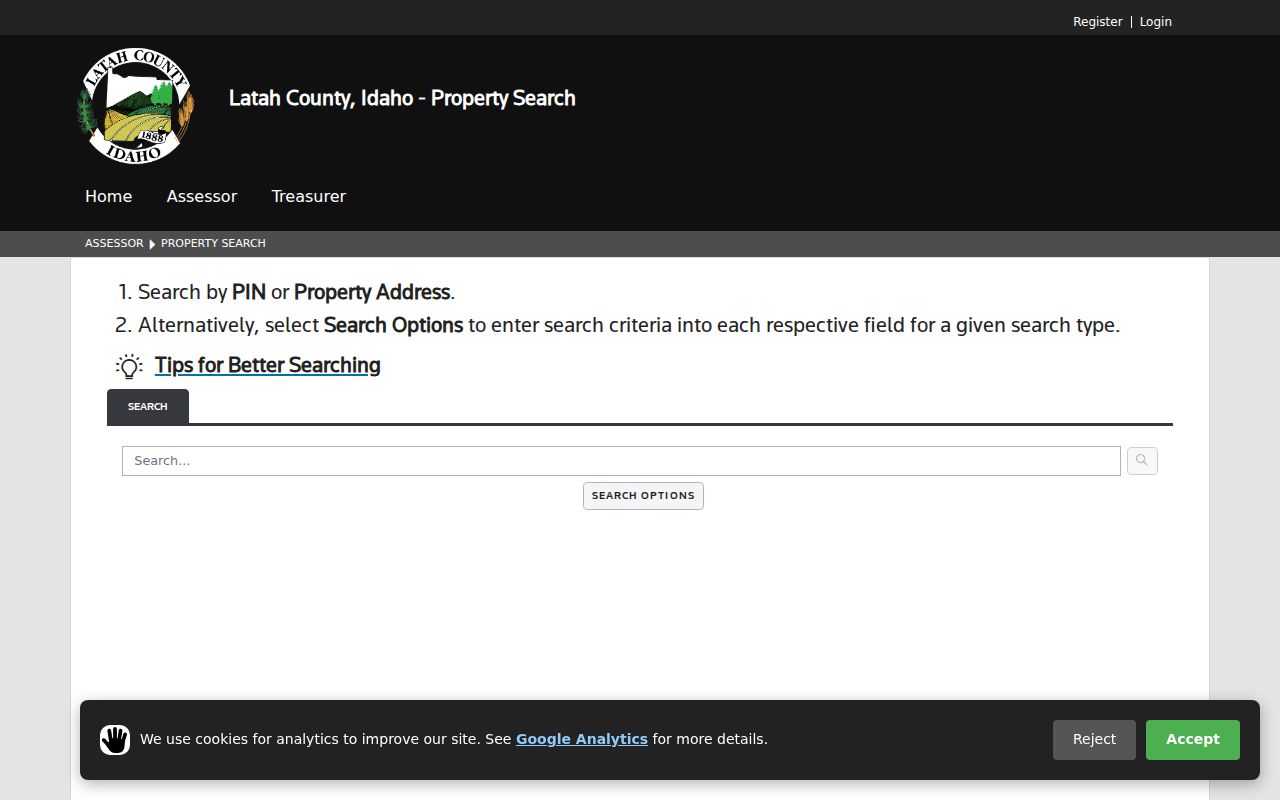
The screen reinforces the right order. Find the parcel, read the owner of record, then confirm the newest recorded deed.
Access Latah Owner Records Offline
A failed portal is not the end of an owner search. Call the Assessor at (208) 883-5710 with questions about the current ownership file. Recorder staff are at 522 S Adams Street, Room 101, Moscow. They handle recorded instruments and official copies of Latah County property records. County offices are listed as open Monday through Friday from 8 a.m. to 5 p.m.
A focused request should carry the property address and full PIN. Include the known owner spelling, date range, and any deed number already found. Idaho Public Records Act requests go to the agency holding the record. State guidance allows ten working days for resident responses. Nonresidents get thirty-five calendar days, subject to the law's terms and exemptions.
For an older document, ask whether the record sits at the counter. It may rest in courthouse books, or be available by office copy request. A portal limit never expands access to confidential material. Public availability does not justify broad republication of personal data.
Separate Latah Owner Addresses
Three different addresses can surface in one owner search. The situs is simply where the parcel sits. The mailing address gets county notices, and it may be a post office box, a business, a trust contact, or even an out-of-state spot. Plat terms and boundary wording make up the legal description.
A mailing address proves nothing about where someone lives. It does not show the owner is present either. Keep both old and new street numbers after a change, then check the PIN and legal description against each other. County Planning & Building takes applications for new rural addresses, and a parcel can sit without a normal street number for a while.
A Moscow, Genesee, or Troy mailing label does not decide city jurisdiction. For that boundary question, use the county GIS Incorporated Places and Area of City Impact layers. Ownership itself still comes from assessor and recorder records.
Audit a Latah Owner Result
Keep enough detail to rebuild the owner lookup later. Note the search date and the source URL. Note the query text, PIN, owner spelling, and both addresses. Jot down the legal description, assessment year, deed number and date, and any online image limit. Tag each fact with its source so nothing gets blurred.
This discipline keeps an assessor field from masquerading as a deed fact. It also stops a GIS shape from standing in for a surveyed boundary. If the result you inspect lacks a field, mark it not shown. Do not guess from a generic parcel card.
Latah GIS adds context: address, lot lines, city limits, impact areas, zoning, and service districts. Treasurer records help separate parcel-account categories. Neither source substitutes for the recorded ownership transfer. That transfer is the fact which settles who owns the parcel of record.
Verify Latah Deed Claims
Latah County publishes no official property-fraud alert service. A letter or caller may claim ownership changed. Search the stated instrument number in the Recorder's official index yourself. Then compare it against the parcel deed history. Skip the sender's copy and any callback number they offer.
Watch out for overpriced deed-copy offers. The county's posted route costs $1 per page plus $1 certification per document. Ask the Recorder whether an instrument is genuine and current. Do that before you pay an outside solicitor anything.
Report a suspected forged instrument to the Recorder and the Latah County Sheriff's Office. The record search shows what was filed, at least. Sorting out the legal effect of a disputed deed may take a lawyer.
An ownership lookup can name the current label on the roll. It can tie that name to a parcel. And it can point you to the newest recorded transfer. It cannot certify title. It cannot reveal an unrecorded interest, prove occupancy, or settle a boundary dispute. Sometimes a trust or entity is the whole public answer.
A freshly recorded deed can land before the roll catches up. The county gives no fixed refresh time. So compare the roll against the latest instrument, especially right after a sale. More on that present-tense comparison appears on the Latah County current owner page.
Limit Latah Owner Conclusions
An ownership lookup can name the current label on the roll, tie it to a parcel, and point you to the newest recorded transfer. It cannot certify title. It cannot reveal an unrecorded interest, prove occupancy, or settle a boundary dispute. Sometimes a trust or entity is the whole public answer.
A freshly recorded deed can land before the roll catches up. The county gives no fixed refresh time. So compare the roll against the latest instrument, especially right after a sale. More on that present-tense comparison appears on the Latah County current owner page.
Not title proof. A Latah County owner name may be dated or may name an LLC or trust. Confirm the newest deed and use public information only for lawful property research, never harassment.