
Read Latah County Deed Records
The Latah County Auditor/Clerk/Recorder records property instruments under Idaho Code §31-2401. A recorded deed shows the named parties. It also lists the document type, a recording reference, and a legal description. Recording proves the document entered the public record. It does not prove the land is free of older liens, easements, claims, or unrecorded interests.
| Deed Type | What It Does | Common Use |
|---|---|---|
| Warranty deed | Conveys title with stated covenants | Ordinary sale transfer |
| Quitclaim deed | Transfers whatever interest the signer has | Family or title cleanup |
| Personal representative deed | Conveys through an estate representative | Probate transfer |
| Trustee deed | Conveys under stated trustee authority | Trust or foreclosure setting |
| Tax deed | Records a transfer through the tax-deed process | Delinquent-tax property |
A deed conveys an interest in land. A deed of trust works differently: it secures a debt. A reconveyance or satisfaction can later release that debt. These instruments sit near true transfers in a party search. So avoid reading them as new ownership deeds. Match each one to the same legal description before drawing conclusions.
Search Latah Recorder Fields
The county index offers the terms a focused deed search needs. Enter a party name surname-first, or use an instrument number for a direct route. Each result identifies the document, book and page, party name and type, document type, and total pages.
| Field | Meaning | Best use |
|---|---|---|
| Name | Indexed party | Grantor or grantee trail |
| Instrument number | Exact document key | Direct retrieval |
| Party type | Role on filing | Separate giver from receiver |
| Book and page | Legacy reference | Book or copy request |
| Total pages | Document length | Spot the image limit |
See Latah Recorder Results
The official Recorder index displays name and instrument controls with result headings.
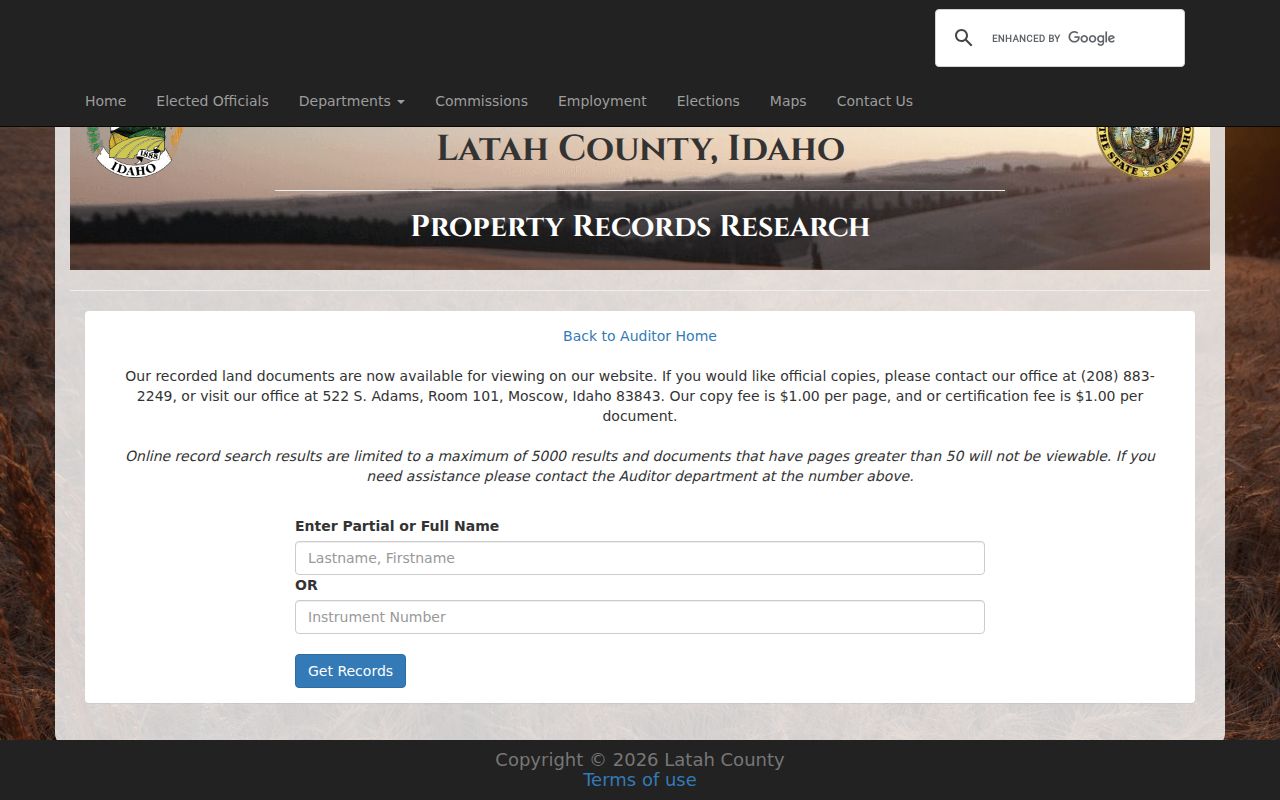
The view shows the interface, not a live transfer. Results stop at 5,000, and documents over fifty pages require another access channel.
Use Latah Parcel Deed History
The Assessor deed-history screen requires the PIN from an address search. Its headings cover owner, legal description, parcel number, deed number, deed type, date, and description. That makes it the cleanest bridge when an address is known. Indexed owner spelling is not needed.
Carry the deed number back into the Recorder index. Match the parcel description and the recorded parties. That keeps a same-name result from attaching to the wrong tract.
Vary Latah Party Names
Indexes keep names as filed. Try exact spellings and surname-first forms. Try initials, omitted middle names, and former names. Also try estate or trust labels and entity punctuation. A person can appear as trustee, beneficiary, spouse, claimant, grantor, or grantee. That person may never be the current owner.
Let the legal description serve as the steady thread. Lot, block, subdivision, or metes-and-bounds wording should link each step, even when the address changes.
Walk Latah's Grantor-Grantee Index
The Property Records Research portal searches a party name in “Lastname, Firstname” form or an instrument number. Each result lists the document, book and page, party name, party type, document type, and total pages. A grantor gives an interest; a grantee receives it.
- Find the current owner's acquiring deed, with that owner shown as grantee.
- Read the grantor and legal description from the instrument.
- Search that grantor as an earlier grantee, checking name variants and party roles.
- Repeat while the legal description and references remain consistent; ask for books or microfilm when online evidence ends.
- Grantor
- The party transferring the stated property interest.
- Grantee
- The party receiving the stated property interest.
- Chain of title
- The ordered sequence of recorded transfers for a property.
- Book/Page vs Instrument #
- Two ways Latah County identifies a recorded document in its index.
When Fifty Pages Matter
The portal's fifty-page rule is an access limit, not a gap in the record. A long document still exists even when its image will not open online. Save the reference. Then use the counter, phone, or written request route. Broad searches also stop at 5,000 results. An instrument number or tighter party form can avoid the cap.
Latah offers no official deed-fraud alert signup. Owners should check the index. They can also ask the Recorder whether a notification option has since been added.
Latah's 1888 Transfer Story
Congress created Latah County on May 14, 1888. The act required Nez Perce County to furnish transcripts of records, indexes, and documents. These were needed to perfect Latah records. A pre-county trail may survive elsewhere. It might be an original, a transcript, or a later index entry.
FamilySearch catalog leads include deeds from 1888 through 1907. There is also a deed index through 1906, and miscellaneous courthouse records through 1935. These are collection runs, not a claim of full online coverage.
Match Latah Plats to Deeds
A legal description may cite a subdivision, lot, block, survey, or plat. The Assessor plat index lists sheet, subdivision, index number, location, type, plot date, and PDF. Historic University of Idaho resources hold 1914 and 1937 county atlases. They also hold Metsker atlases from 1938 and 1960.
Maps translate old land language. They do not convey title. Match the plat to the deed. Call a surveyor when a boundary's ground position is disputed.
Check Other Latah Instruments
Deeds of trust, reconveyances, assignments, liens, releases, easements, rights-of-way, and lis pendens can all appear near a transfer. They burden or release an interest without changing ownership. Search current and prior parties. Then match any release to the original instrument number and land description.
For an address-first route before deed work, use the Latah County property search.
Order a Latah County Deed
Start with the online image when one is available. Documents longer than fifty pages cannot be viewed through the portal, so contact the Recorder at Room 101, 522 S Adams Street, Moscow, or call (208) 883-2249. Plain copies cost $1 per page. Certification adds $1 per document. Give staff the instrument number or book and page, party names, recording date, and document type to avoid a broad search.
Recorded, not guaranteed. Latah County deed records show filed instruments, not a title opinion. Unrecorded interests may exist, and a professional title search is needed for clear-title assurance.
Build a Latah Deed Packet
Pull a Latah County deed. Record the details that tie the paper to the parcel. That means the recording date, the number, book and page. It also means the document type, grantor, grantee, party roles, legal description, and total pages. Label each source plainly. Was it an index row, an online image, a plain copy, or a certified copy? The label keeps a search result from being mistaken for the deed itself.
Hold off on adding releases, reconveyances, easements, or court orders. Add them only once their references and land descriptions match the parcel. A deed of trust or an assignment can carry the same names as a conveyance. It may move no land at all. Before ordering every hit under a common surname, ask the Recorder which certified items the job actually needs. Your Latah County property records packet will be leaner and far more reliable for it.
Distinguish Latah Recording Fees
Recording fees and copy fees pay for two different acts in Latah County. The county charges $45 to record a deed of trust or mortgage. That price covers up to thirty pages. A reconveyance or satisfaction runs $15. Other instruments cost $10 for the first page. Each added page is $3 more.
Copies of existing deed records run $1 per page. Certification adds $1 more. Ask the Recorder to confirm the total before you send payment. Also ask whether a reference points to one document or several. One caution belongs here. A high-priced solicitation is not the county fee schedule. So treat any offer that inflates these numbers as noise rather than official Recorder pricing.
Confirm the Latah Chain
A clean chain of title keeps the same land description through every transfer. That transfer record lives in Latah County property records. The chain also explains each split, combination, or new plat along the way. Stop the moment a party name matches but the land does not. That is simply a different chain.
A gap in the deed records calls for a question. Never guess an owner of record. Ask Recorder staff whether the missing period sits in a deed book, on microfilm, among records transferred from Nez Perce County, or in a later index. Then preserve that answer alongside your chain notes.
Follow Latah Deeds Offline
The online index states neither its earliest year nor its imaging cutover. Treat its first hit as a convenience, not the start of county ownership history. Save the last online reference you find. Then ask Recorder staff which record carries the chain backward. It may be a book, microfilm, transcript, or reconstructed index.
Older Latah deed records have well-marked trails. FamilySearch catalog entries point to deed volumes from 1888 through 1907. They also list an index covering 1888 through 1906. Miscellaneous courthouse records extend through 1935. The 1888 county-creation act matters too. It required Nez Perce County to supply the records Latah needed. A pre-county conveyance may therefore sit in another county or along a federal land trail.
When you request an older volume, supply the party names and estimated year. Include the land description and the last known book or instrument. Ask whether the copy comes from an original, a transcript, or a later index. Keep that answer. It explains the true source of your chain.
Read Latah Legal Descriptions
A street address is easy to say out loud. It can also change. The lot, block, subdivision, or metes-and-bounds language in a Latah County deed is the safer bridge between transfers. So copy it verbatim and note every abbreviation. Then compare that same tract language across each deed, plat, assessment record, and release you touch.
The Assessor plat index searches by subdivision. It shows sheet, index number, location, type, plot date, and PDF for each entry. PlanningCombined adds lot, block, subdivision, and parcel annotations on top. Those tools help you locate the relevant plat with ease. Ownership still comes from the instrument, though. A boundary dispute needs survey evidence rather than a map alone.
Recheck Recent Latah Deeds
Run your party and instrument search one more time before relying on any recent chain. A later deed, correction, release, or court-related filing can land in the Recorder's index after your first pass. Save the new access date and compare references. When timing matters, ask Recorder staff whether the index and the image are both fully posted.