
Compare Latah County Property Values
A value lookup in Latah County works best when you know which number you are holding. The assessor's value, a recorded sale price, and a current market opinion each answer a different question. Treat them as separate figures, and check the date on any Latah County property value before you rely on it.
| Value type | Meaning in a property file | Record source |
|---|---|---|
| Assessed market value | The Assessor's mass-appraisal estimate as of January 1 | Assessment roll and notice |
| Taxable value | The assessed base after applicable exemptions or statutory adjustments | Assessment and tax records |
| Last sale consideration | An amount printed in a transfer record when the instrument exposes it | Recorded deed or transfer document |
| Current sale estimate | An opinion for a current transaction, not a county record | Licensed appraisal or market analysis |
Keep notes as you go. Save the parcel PIN, the assessment year, the valuation date, and the source right beside every figure you copy from Latah County property records, because values from different years can pass themselves off as comparable when nothing labels them apart.
Latah County Values on January 1
Idaho law assesses property at market value, per the Latah County Assessor. The valuation date falls on January 1 each year. Sales from the prior year help support the estimate. That makes the figure a snapshot for the assessment system rather than a promise of what a later sale would bring.
Physical reappraisal happens at least once every five years. Between visits, the assessor may apply annual market adjustments drawn from sales evidence. So a sharp jump in your Latah County assessed value often reflects the market, not a fresh inspection of the parcel. Check the tax roll for the year behind any change before assuming an appraiser walked the property. A jump and a visit are two very different things.
Find Latah County Assessed Value by PIN
The Latah County Assessor Public Access portal takes either a parcel number or a property address. Less address detail returns more results. A wildcard can widen the property search further, the official instructions note, which helps when a deed records the street name slightly differently than you expect.
- Search the situs address and compare possible matches by map position.
- Copy the full six-to-fifteen-character PIN, including letters.
- Open the parcel result and record the assessment year and owner label.
- Capture land, improvement, market, exemption, and taxable fields only if the live card displays them.
- Keep a source date and compare the same fields across years.
The image shows the official Latah County public search entry page in its blank state, before any parcel number has been entered. The county's parcel detail fields load only after a query, so treat the screenshot as the doorway to the assessed value lookup rather than the record itself.
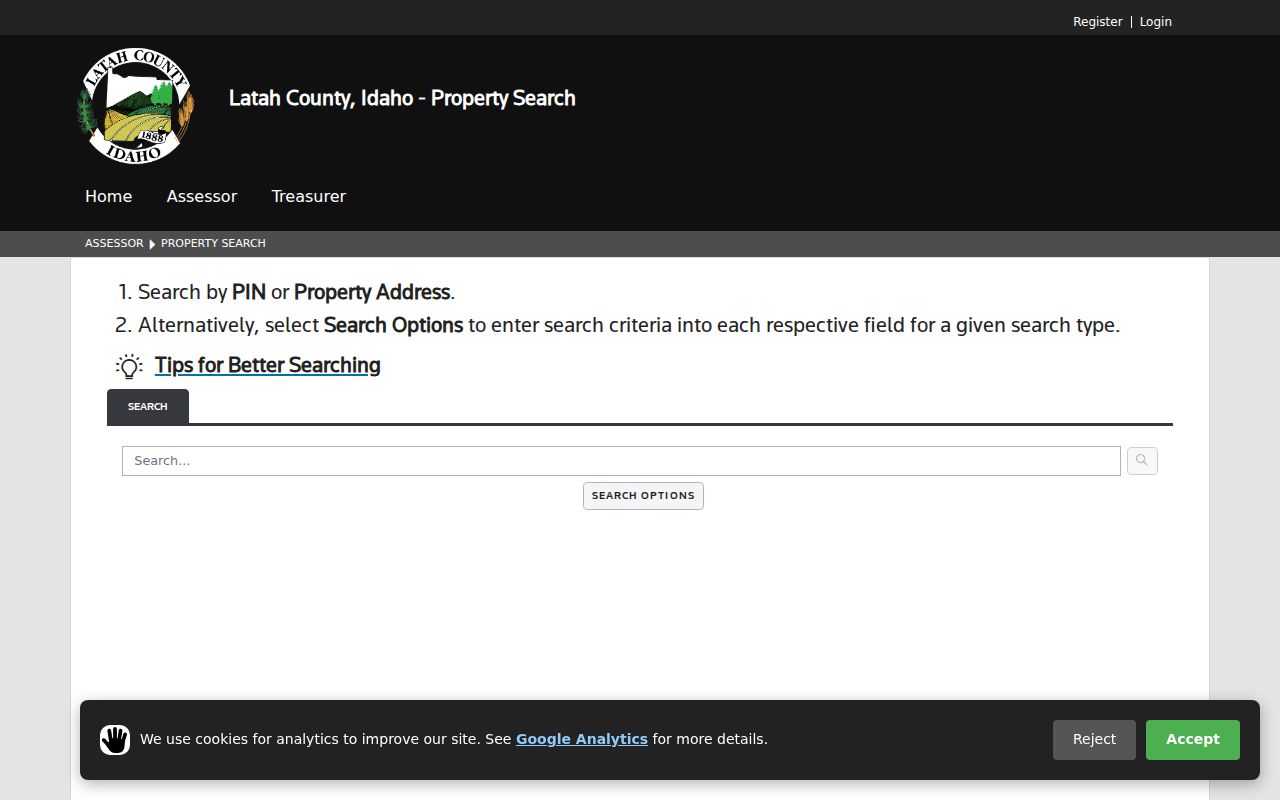
Treat whatever the parcel card shows as the official roll entry for that assessment year. That is the assessor's number of record. If your question is about sale history instead, a deed search fits better; for a professional opinion of value, look to an appraisal rather than the tax roll.
Read Latah County Value Fields
A Latah County parcel card splits its numbers in ways that matter. Land value covers the site itself. Improvement value covers the assessed structures on it. Taxable value is what remains after any exemption, and the county uses that figure as the base for the tax system.
- Assessed value
- The Assessor's mass-appraisal figure for the statutory valuation date.
- Market value
- The amount the Assessor estimates property would bring in an open-market exchange under Idaho's method.
- Assessment ratio
- The relationship between assessed and market value; Latah describes assessment at market value.
- Sale consideration
- An amount associated with a recorded transfer, if the deed or portal actually shows it.
- Reassessment
- A new valuation through the physical cycle or an annual market adjustment.
How Exemptions Change Taxable Value
Exemptions lower the taxable base. They do not rewrite the assessor's estimate of what the whole property is worth. Latah County's homeowner exemption works this way, and other exemptions follow the same pattern.
The county's exemption page sets an April 15 deadline. Owners file or renew certain tax-exempt property status by that date. Annual Board of Equalization renewal applies under Ordinance 265.
A lower taxable number is therefore not proof of a lower land-and-building estimate. Keep the two ideas separate. Levies, due dates, bills, and appeals go beyond this page. For those, turn to the Latah County property tax records guide.
Latah County Value Account Types
The Latah County Treasurer splits value accounts into a few types. RP covers land, while OC marks the occupancy roll and MH marks manufactured homes. One detail matters here. A structure can carry its own assessment or tax bill. It stays separate from the land beneath it. So do not assume two entries at one spot mean two titled parcels. The property records simply track them apart for tax roll purposes.
This account-type check earns its keep when a total looks too low for the property. It also helps when a Latah County property search returns what seems like a duplicate listing.
Recorded Price Versus Latah County Value
A recorded deed may state consideration or carry a transfer reference. Even so, the assessor card's last-sale field is not a figure to lean on. A safer route exists. Open the Assessor's deed-history screen. Note the deed number and date. Then pull the Recorder's instrument image or copy to read the deed records for yourself.
Some transfers never reflect a true market price. Family deeds, estate transfers, and quitclaims are common examples. Multi-parcel sales and nominal consideration can also sit far from arm's-length value. Treat those deed records carefully. Never force an unverified transfer amount into a comparison. That figure may not match a current Latah County property value.
Compare Latah County Property Values Across Years
Line up the same parcel number and the same field for every year you compare. Note whether a physical reappraisal, annual adjustment, exemption, remodel, or land division altered the record. A separate occupancy account can change it too. Shape can change as well. If a parcel was split or merged, the legal description may be steadier than the old PIN. Rely on it when tracing Latah County property records over time.
| Capture item | Reason to keep it |
|---|---|
| Assessment year and January 1 date | Prevents mixing valuation snapshots |
| Land and improvement amounts | Shows which component moved |
| Exemption and taxable amount | Separates tax treatment from market estimate |
| PIN and legal description | Confirms the same property is being compared |
| Deed date and consideration, if shown | Keeps transfer evidence separate from assessment |
Get Latah County Values Offline
Some value questions are easier to settle by phone. The Assessor, at (208) 883-5710, can explain a historical field on a property record card. It can also walk you through one that will not load. The annual assessment notice is another direct source worth requesting. For a recorded transfer, the Auditor/Clerk/Recorder offers an online deed index. It also provides counter service at 522 S Adams Street, Room 101, Moscow, phone (208) 883-2249, and copy requests.
A record may exist but sit outside any online search. The Idaho Public Records Act is the tool then. Name the parcel, the year, the record, and the office that holds it. The Treasurer cannot turn a tax bill into an appraisal, so skip that ask. Each custodian explains only the record it keeps.
Latah County Property Value Limits
A county figure is not a sale price. It is not a lender's collateral opinion either. It is not a statement on structural condition, title quality, a surveyed boundary, or repair costs. What it is: a mass-appraisal result built for assessment administration. It is pinned to a specific date. Treat it as a public data point. It is not a verdict on what a parcel would fetch on the open market.
Value is not price. An assessed value is not what the property will sell for and is not a licensed appraisal for a current transaction.
When current market value is the real question, hire a professional appraisal. Keep assessor figures in their lane as consistent, public, parcel-linked evidence for understanding Latah County property value.